|
Part Fourteen
[Note: September 2024 - Elsinore Mk6 is current - some
things may be obsolete]
Needs updating as info below
applies to Mark 1 version of Elsinores.
For details pertaining to
Mark 2 & 3: Elsinore Mk 2
& 3 Crossover & Notes
Tweaking the Crossover
There may be some reasons to tweak the crossover.
-
Some Amplifiers have High
Output Impedance (frequency response is modulated)
-
Speakers used in acoustic
environment that is deader than normal
-
Speakers used in acoustic
environment that is brighter than normal
-
Some users may like slightly
more vocal projection.
-
Voicing the balance, maybe
useful for troublesome rooms
First look at the crossover and
suggestions below that.
Please Note, only
Elsinore Mark 1 Crossover
(OLD
CROSSOVER)
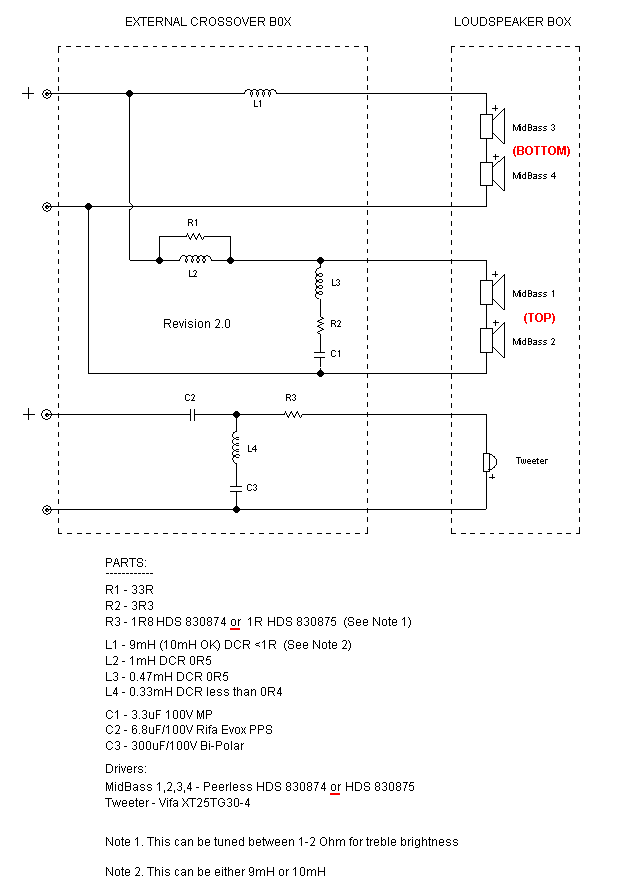
The recommended order of component's values that could
be tweaked are as follows:
R3 This can be reduced to
below 1R, especially if using Nomex coned drivers.
R1 When the amplifier has
high output impedance, such a single ended tube amps or amps that have zero
feedback. If R1 is decreased to below 10R - but never below 5R - then R3
will have to be reduced to zero, that is just a wire and not a resistor.
Under these circumstances, reducing R3 will counter a drop in the response
above 2KHz and likewise the shortened R3 will match that out put.
L3 Reducing this value
will increase vocal projection, but it should not be below 0.5mH - and R1
should now be changed with increasing care (maybe best not changed). Try
0.8mH first.
L1 Reducing this value
was found to lessen the overall "ripeness" of the speaker. This is of course
a tonal subjectivity and a voicing of the speaker. This could also be useful
for smaller rooms where the powerful sound of the Elsinores can be a
problem. Try 5-6mH.
It is not recommended that any of the other
component values be changed. This would largely necessitate a modelling
program from scratch (the parallel networks are tuned to critical
frequencies). The above tweaks are only useful because of the sonic changes
that can be expected.
|

























